
Future updates on our projects and travels can be found at M382pilgrim.blogspot.com
We will continue to maintain this blog, but do not expect to add posts.
Tuesday, December 31, 2013

Monday, November 18, 2013
SV Pilgrim - the next chapter in our adventures at sea
It is official we have purchased a 1979 Morgan 382 – SV Pilgrim.

After spending time aboard all three of our top choices –
Tartan 37, Bristol 35.5, & Morgan 382, we choose to purchase the
Morgan. Why the 382?
We were swayed by the recommendations we found by current
and past owners on line. Consistently
the design received praise as a sturdy, comfortable vessel capable of bluewater
sailing. Along with chronicles of full
time cruisers living aboard M382s, I found many accounts of Morgan 38’s
completing ocean transits and circumnavigations.
First hand observations…
On deck the M382’s 6” bulwarks and cabin top mainsheet set
her apart from the Tartan 37s or the Bristol 35.5.

Her cockpit is spacious and appears comfortable. We will need to get used to wheel steering.

The interior layout is fairly standard.

One standout feature is a separated shower stall in the
head. We were wowed by the amazing
amount of storage below decks – dramatically more than other vessels we
viewed. System’s wise the 382 has more fresh water and
fuel tankage than either the Tartan or the Bristol.
There are some down sides to the M382…
·
With a fin keel & skeg hung rudder She draws
5 feet - a foot more than either the Tartan or the Bristol centerboard designs.
·
Due to fine entry lines her vee berth is on the
narrow side – smaller even than the vee berth in C’est la Vie, a Morgan 34.
·
She is powered with 30HP Yanmar. By modern standards 30HP is not much for a
vessel displacing 18,000 pounds. C’est
la Vie, our M34, displaces 12,500 and has a 34HP engine.
A bit of timing and chance also fit into the purchase. For the price we were unable to find a Tartan
or a Bristol that matched the condition and systems present on SV Pilgrim.
We have very little information on her history.
We believe she is hull #115. In the 90’s she was named Pupa
and based in the Miami, FL area. Circa
1998 she was purchased by the most recent owners and moved to Lake Erie. They did a wonderful job maintaining
her. Both inside and out her paint and
brighwork are in good condition. They replaced
the rig and ran all the control lines aft in 2002. The engine was rebuilt in 2010. Recently they have replaced all the ports
with new stainless steel NFM ports. The
dodger appears to be brand new.

There is work to be done…
1.
Replace main sail
2.
Replace all Running Rigging
3.
Update Electrical System – control panel,
lighting, battery bank, etc. – much of this will be pulled from C’est la Vie
4.
Install PV System & Solar Panels – pulled from
C’est la Vie
5.
Install Wind Generator – pulled from C’est la
Vie
6.
Update instruments – VHF, wind, depth, plotter,
etc. – much of this will be pulled from
C’est la Vie
7.
Replace current LP stove with stove from C’est
la Vie
8.
Improve storage & handling on foredeck. – add a second anchor roller, and the windlass from C’est la Vie
9.
New antifouling paint.
I’m certain the list will evolve and
grow once we spend some time aboard. But
first we need to get her down to Beaufort, NC.
We have contracted a trucking company to haul her south. They promise to have her in Beaufort by
December 15.
We have started a new website devoted to SV-Pilgrim - M382Pilgrim@blogspot.com We hope you all will continue to follow our adventures as we continue towards the horizon.
Friday, November 8, 2013
Time to break the silence...
Dealing with the emotional wounds from the dis-masting is a
much longer endeavor than either of us imagined. Our
healing process has lead us to question what’s next. Do we want to continue sailing? What about sailing offshore?
Do we want to continue to pursue or goal of spending a couple years
aboard in the Caribbean?


With a refreshed sense of purpose we can now confidently
state that we are committed to pursuing our goal of cruising the Caribbean. I’m certain that when we next hoist our
sails and set a course offshore both of us will feel a flush of
anxiety as we dwell on C’est la Vie’s dis-masting.
We have decided to search for a new boat on which to
continue our journey. This has not been
an easy decision for us. I am not going
to attempt capture or share the process by which we reached this
conclusion. We are not seeking outside
input or for others to question the path we have chosen. We do want to continue to share with you all
our progress forward
What are we seeking in a new vessel? We cherished the Morgan 34’s classic lines,
her shallow draft, her fine sailing ability on all points of sail, her wide
side decks, and her solid construction. We want to retain as many of
these features as possible yet gain...
- Increase in offshore sailing capability/comfort by seeking greater displacement, additional free board, a bridge deck between cockpit and cabin.
- Increase in tankage – specifically larger water and holding tanks
After many hours of research and discussions with
experienced sailors we narrowed our search to three models.
Bristol 35.5 – Ted
Hood designed centerboard sloop with a reputation for excellent sailing
characteristics. She is 35.5’ LOA, 11’ Beam, and 15,000 Lbs displacement.
Tartan 37 – Sparkman
& Stevens design centerboard sloop.
She is 37.4’ LOA, 11.75’ Beam, and 15,500 Lbs displacement.
Morgan 382 – Ted
Brewer design with an reputation as a solid blue water boat. She is LOA 38.3’, Beam 12’, 17,000 Lbs displacement.
I have now been aboard all three vessels. We were able to sail aboard our friend’s
Tartan 37, Carribean Soul. Thanks to Penny & John for the fine
evening sail.
We have had an offer accepted on one of these boats and are
moving through the process of purchasing… survey, USCG abstract, etc. We are reluctant to share more details until
we close the deal. Stay tuned!
What about C’est la Vie’s dis-masting? We believe the mechanical failure of a
critical rigging component installed in fall 2011 lead to the dis-masting. We are under advisement not to discuss the
matter publicly at this time. We hope to
share the details at a later date.
Saturday, August 3, 2013
Racing and Cruising SV Seraphim in the Great Lakes
Thanks to the captain and crew of SV Seraphim for inviting Anne and I to participate in the 2013 Port Huron to Mackinac Island Race.
We did not place well in our PERF Class due to some strategic errors based on predicted winds and a jammed halyard that forced us to send a crew member to the masthead during the race.
We did learn a great deal... racing is very different mentality than our typical cruising lifestyle. We also enjoyed getting to know the Seraphim Crew.
more images from our travels are available in our photo album... Racing and Cruising SV Seraphim in the Great Lakes
 |
| Mackinac Island Marina - the finish line for the 204NM Race |
 |
| Pete aloft attempting to free the jammed stay sail halyard |
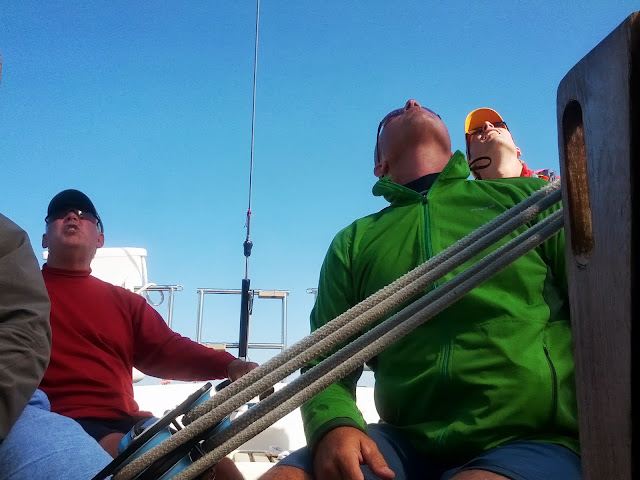 |
| The crew looking on as Pete works at the mast head. |

We did learn a great deal... racing is very different mentality than our typical cruising lifestyle. We also enjoyed getting to know the Seraphim Crew.
After the race Anne, Bill (Anne's father), and I were responsible for sailing the boat back to Cleveland, OH. Our return trip included travels through the North Passage; Georgian Bay; Tobermory, OT; Detroit, MI; and Put-In-Bay, OH.
 |
| Bill at the helm as we depart Gore Bay, OT |
Our two weeks on Seraphim, a Pretorian 35, gave us time to distance ourselves from C'est la Vie's current woes and experience traveling aboard a different sailing vessel. Thanks to Karim for trusting us with his boat and allowing us to experience a new sailing venue.
 |
| Anne at the helm as we enter Put-In-Bay, OH |
Sunday, July 14, 2013
Dis-masted - Afterward
There are three entries that proceed this post. Here are the links
Part 1
Part 2
Part 3
Losing the rig is undoubtedly unfortunate, but Anne and I whole heartedly agree that we were fortunate in the timing and location of the event. We can think of many, many worse scenarios. We are thankful for the support of our friends and fellow cruisers.
Part 1
Part 2
Part 3
Losing the rig is undoubtedly unfortunate, but Anne and I whole heartedly agree that we were fortunate in the timing and location of the event. We can think of many, many worse scenarios. We are thankful for the support of our friends and fellow cruisers.
Why did the dismasting occur?
The system
of windward lower stays suffered a mechanical failure. Once the windward lowers were no longer in
place the force exerted by the windward cap shroud on the spreader caused the
mast to fold to leeward. Fortunately for
us the pressure on the sails carried the mast clear of the deck and hull before
causing structural damage. From our
findings in the days after the incident we believe the mast struck the port
side cowling then my paddleboard, lashed to the leeward lifeline, and then
entered the water. We are not going to provide additional, detailed information
until we correspond with the company that manufactured the part whose failure
we believe caused the dis-masting.
How do we know the windward lowers failed?
We observed
the mast fold to leeward in the area of the spreaders. The system of failed windward (starboard)
lowers were no longer attached to the mast when it entered the water. Thus, the
starboard side lower stays, including a portion of the part we believe caused
the failure, remained on deck once the rig was gone.
Lessons we are taking away from this
experience…
1. Include
a stout set of cable cutters in your on board tools. These enabled us to efficiently cut the
downed rig away before it was able to compromise the integrity of our
hull. I was pleased to discover our
cable cutters were able to sever dyneema dux when it is under load.
2. Have
an efficient system for rigging an alternate VHF antenna or a secondary VHF
unit. We were unable to reach anyone via
our hand held VHF. Most sailing vessels have their primary VHF antenna mounted
atop the mast. In a dismasting this
antenna will be lost. The ability to
rewire the VHF to a secondary antenna mounted on the stern of C’est la Vie
allowed us to contact the USCG.
3. We
believe C’est la Vie’s rigid bobstay saved the bowsprit. With only a wire for a bobstay the loss the
forestay would place all the weight of the anchors and other forces on two
horizontal attachment points. I have
little doubt the bowsprit would have failed when I went forward to cut away the
forestay or during our lumpy trip back to the mainland if it lacked the support
of the solid bobstay. With some extra
care we were also able to use the anchors and windlass in the days following
the incident.
4. Never,
never, never make light of a mast-less sailing vessel underway. We were amazed at the callousness of the
first motor vessel that asked us, “aren’t you missing something?” We though the person must just be a bit socially
awkward. Later in the day a second
passing motor vessel attempted to make another humorous comment about our lack
of a mast. Hurt, we discussed together how motor vessel operators are simply
clueless. Despite damage to our lifelines,
bent stanchions, and the stump of roller furling unit at our bow, on day two in
the ICW we passed a southbound sailboat that shouted over, “did you forget
something?” WTF! These comments were simply pouring salt into
our wounds.
It took us
two days of motoring northward along the ICW to reach Beaufort, NC. During the trip we took some time to lick our
wounds and discuss what to do next.
 |
| Anne relaxing with a cucumber "mask" |
Our wonderful
Beaufort friends welcomed us back and were generous in their assistance…
finding us free dockage, providing place sleep on land, and plenty of good food
and drink.
 |
| C'est la Vie docked in Taylors Creek |
- Haul C’est la Vie in Beaufort, NC
- Crew aboard SV-Seraphim, a Pretorian 35, in the upcoming Port Huron to Mackinac Island Race
- Deliver SV-Seraphim back to Cleveland, OH after the race
- Work in the Beaufort, NC area in the late summer.
prior to
making any decisions about the next steps. We hope through time we will gain
perspective. We also hope that time will
present options or opportunities that are currently hidden from view by our
proximity to the dis-masting.
Saturday, July 13, 2013
Dis-masted- Part 3
Dis-masted - Part 1
Dis-masted - Part 2
Years ago when installing a new AM/FM radio I wired a male/female coupling in the co-axial antenna wire. Located in the electrical panel the joint could, in the event of a lost or damaged masthead antenna, allow us to connect the VHF to the AM/FM antenna without the need of additional tools or soldering.
Dis-masted - Part 2
Years ago when installing a new AM/FM radio I wired a male/female coupling in the co-axial antenna wire. Located in the electrical panel the joint could, in the event of a lost or damaged masthead antenna, allow us to connect the VHF to the AM/FM antenna without the need of additional tools or soldering.
Unfortunately,
I never installed a similar joint on the VHF antenna in the electrical
panel. The closest fitting on the VHF
end was forward in the boat where the wire entered the mast compression
post. And so it was, I found myself
removing floor boards and pulling wire while Anne piloted C’est la Vie towards
the Cape Fear River. Rerouting the VHF
cable back to the electrical panel consumed vastly more time than the actual
rewiring.
 |
| Running the improvised VHF Antenna through the open electrical panel |
Unfortunately, the hot engine and spinning belts prevented
me from routing the wire in a manner that would allow the electrical panel to
close. Floor boards asunder and the
electrical panel exposed, I connected the VHF to the AM/FM antenna. We now had a VHF that would allow us to
communicate with other vessels.
The USCG Charleston Sector replied immediately to my hail. I stated that we were a dismasted 34 foot
sailing vessel in the process of assessing damage. Succinctly we progressed through her
questions… Location? Injuries? Number of people aboard? PFDs for
everyone? Description of vessel? Are you requesting assistance?
I looked around C’est la Vie. The roller furling drum struck the bowsprit
railings like metronome in time with the rolling seas. Severed remnants of standing rigging littered
the deck. Piles of mingled running
rigging sat idle in the cockpit.
 |
| Running rigging splayed about the cockpit after cutting away the rig |
I scanned the horizon
– only sea and sky for 360⁰. I glanced
back to Anne at the helm. Before tears
could again overtake me, I replied, “We do not require assistance at this time.”
C’est la Vie’s engine, electrical, and steering systems were
functioning properly. Other than the
single run cycle during the cut away process our bilge pumps remained silent. C’est la Vie’s motion on the heaving seas was
uncomfortable, but we steamed towards the Cape Fear River at over 5 knots.
Surprised that the Coast Guard did not request we check back
in upon making landfall, we concluded our conversation with the radio operator
taking my name and cell phone number.
Still amped up from the surge of adrenalin, I asked Anne if
I could take the helm to busy myself. Anne then recorded the following log entry…
7/5/13 @ 14:53 – 29.1NM to Cape Fear River Inlet G”9” – ETE
5H52m – Course 53⁰ - Speed 5.4kts – “dismasted, motoring in, contacted Coast
Guard.”
The trek into the Cape Fear River stretched into the night. Emotions ebbed and flowed though each of us
often surfacing in tears… sadness at the
damage to our home and our dream; thankfulness that we were uninjured, gratitude
that C’est la Vie was still afloat and transporting back to shore, uncertainty of
the future, and on and on emotions and questions. We agreed to carry on with our plans for the
next month and not make any hasty decisions.
As my mind mulled on our current state, I realized why the
depth sounder was non-functional. NMEA
2000 networks rely on data to complete a full circuit of the instruments and
sensors. If a wire or connection fails
then the data “splatters” and the system fails.
The weather station at the mast head was gone. The broken wire was causing our data to
splatter. Once we cleared Bald Head Island
and the seas diminished, I crawled into the quarter berth and removed the
wiring for the weather station from our NMEA backbone. Success.
Other than the weather data our instruments were back online.
Another realization struck me as we began to mull over
locations for anchoring. Without a
forestay to support the bowsprit the weight of the anchors and forces of raising
/ lowering the anchor were supported solely by three points of contact between
the bowsprit and the hull.
 |
| A summer 2011 picture of C'est la Vie's naked bowsprit. |
We are thankful for C’est la Vie’s solid bobstay. With only a wire for a bobstay the loss the
forestay would place all the weight of the anchors and other forces on the two
horizontal attachment points. I have
little doubt the bowsprit would have failed when I went forward to cut away the
forestay or during our lumpy trip back to the mainland if it lacked the support
of the solid bobstay.
Fatigued and concerned about the stress anchoring may place
on our now stay-less bowsprit, we entered Deep Creek Marina long after closing
hours. We selected the first vacant slip
and landed without incident at 23:07.
continued...
Part 1
Part 2
Afterward & Lessons
continued...
Part 1
Part 2
Afterward & Lessons
Dis-masted - Part 2
Click Here for Part 1
Fortunately, Anne and I were both in the cockpit and clear of all the rigging and sails. My initial scene survey lead me to the port side of C’est la Vie. The rig and sails were visible at the water’s surface. Unsure of the extent of the damage, I told Anne to disengage the auto pilot, put the boat in neutral and attempt to hail Tow Boat US or other vessels in the area. Despite the now sickening motion of the boat rolling in the seas, my initial instinct was to salvage the rig and sails. My effort began with the mainsail sheet shackle at the bail on the boom. By the time I was able to remove the split ring and unscrew the pin, the rest of the rig and sails sank below the boat. A couple thumps resonated through boat as the rig struck the hull underwater. Our broken mast could strike the hull and sink C’est la Vie. This thought convinced me that quickly cutting away everything hanging below the water was our only option. Passing Anne hailing all vessels on the cockpit VHF, I dashed below and excavated the cable cutters from below the vee berth. I vividly recall standing below decks with the cable cutters in both hands saying aloud, “I never thought I would need to use these.”

Returning to the cockpit, Anne informed me that she did not think the VHF would work with the mast head antenna under the boat. Damn, why didn’t I think of that? She went below to retrieve the handheld VHF and continued her efforts. Fearful the backstay could foul the rudder or prop, I began cutting at the stern. I wanted the backstay gone. Hell, I wanted the whole rig gone. Moving along the port side towards the bow of the boat, I began clearing standing and running rigging… the roller furling control line – snip; the genny sheet still on the winch – snip; the starboard side cap shroud puling tight across the cabin trunk – snip; the port side dyneema dux lower stays – snip, snip; the inner forestay - snip. At the bow, I realized the roller furling foil shielded the forestay from the cable cutters. Clearing the forestay required exposing the wire. I shouted back to Anne to get the hacksaw. Moving along the starboard side of the boat to retrieve the saw from Anne, I cut the starboard headsail sheet on the foredeck, and then found no other taut rigging to clear in my trip back to the cockpit.
Fortunately, Anne and I were both in the cockpit and clear of all the rigging and sails. My initial scene survey lead me to the port side of C’est la Vie. The rig and sails were visible at the water’s surface. Unsure of the extent of the damage, I told Anne to disengage the auto pilot, put the boat in neutral and attempt to hail Tow Boat US or other vessels in the area. Despite the now sickening motion of the boat rolling in the seas, my initial instinct was to salvage the rig and sails. My effort began with the mainsail sheet shackle at the bail on the boom. By the time I was able to remove the split ring and unscrew the pin, the rest of the rig and sails sank below the boat. A couple thumps resonated through boat as the rig struck the hull underwater. Our broken mast could strike the hull and sink C’est la Vie. This thought convinced me that quickly cutting away everything hanging below the water was our only option. Passing Anne hailing all vessels on the cockpit VHF, I dashed below and excavated the cable cutters from below the vee berth. I vividly recall standing below decks with the cable cutters in both hands saying aloud, “I never thought I would need to use these.”

Returning to the cockpit, Anne informed me that she did not think the VHF would work with the mast head antenna under the boat. Damn, why didn’t I think of that? She went below to retrieve the handheld VHF and continued her efforts. Fearful the backstay could foul the rudder or prop, I began cutting at the stern. I wanted the backstay gone. Hell, I wanted the whole rig gone. Moving along the port side towards the bow of the boat, I began clearing standing and running rigging… the roller furling control line – snip; the genny sheet still on the winch – snip; the starboard side cap shroud puling tight across the cabin trunk – snip; the port side dyneema dux lower stays – snip, snip; the inner forestay - snip. At the bow, I realized the roller furling foil shielded the forestay from the cable cutters. Clearing the forestay required exposing the wire. I shouted back to Anne to get the hacksaw. Moving along the starboard side of the boat to retrieve the saw from Anne, I cut the starboard headsail sheet on the foredeck, and then found no other taut rigging to clear in my trip back to the cockpit.
Anne took the cable cutters and I started back to the bow with the hack saw in hand. Before I cleared the cockpit, Anne requested that I clip in. Typically, while offshore on C’est la Vie anyone going beyond the cockpit on deck must clip into the jacklines that run along either side deck from the cockpit to the bow. Focused on the task at hand I had jumped into action without donning my PFD or clipping into the jacklines. I donned my PFD, but starboard jacklines were covered with rigging and the portside lines were buried under my paddleboard. I returned to the bow to clear the forestay. Keeping the saw moving in the growing kerf required two hands. While frantically working to clear the foil my torso bounced between the bowsprit rails. Later in the day I would discover the bruising, in the moment I was thankful the rails were keeping me on the rolling deck. Once the cut extended through one wall of the foil, the forces bearing on the thin tube of aluminum quickly tore through the remaining material. I returned to the cockpit, traded the saw for the cutters, and then made my way back to the bow. Again, working in space between the bowsprit rails required some two handed finagling, but the forestay eventually succumbed. I watched the roll of crisp genoa sail cloth sink out of sight.
Thinking the rig is now free of the boat, I turned back to the cockpit. Stanchions on both sides of the hull bent inward. The portside dorade vent was gone. Electrical wires sprouted from the tube in the center of the now naked mast step. My paddle board, originally tied off to the starboard life lines, now lay on the side deck with a couple rips visible in the cover. Snaking my way back to the cockpit I felt an odd jerk in C’est la Vie’s side to side motion. It felt like being restrained by a seat belt in a car making a sudden stop. Realizing the rig was still hanging below the boat, I started back up the port side and discovered the intact cap shroud stretched taunt between the chain plate and the dark surface of the ocean. The wire cut easily. Our mast, two year old standing rigging, two year old genoa, one year old whisker pole, and 8 month old mainsail were now drifting to the bottom, 75.1’ below.

At some point in the following 24 hours I realized the blind luck of missing the port side cap shroud on my initial pass. If I had cut the shroud on my way to the bow, then the entire rig would have hung from the forestay while I struggled to cut through the foil. I have no doubt the forces involved would have destroyed our bowsprit.
Thinking the rig is now free of the boat, I turned back to the cockpit. Stanchions on both sides of the hull bent inward. The portside dorade vent was gone. Electrical wires sprouted from the tube in the center of the now naked mast step. My paddle board, originally tied off to the starboard life lines, now lay on the side deck with a couple rips visible in the cover. Snaking my way back to the cockpit I felt an odd jerk in C’est la Vie’s side to side motion. It felt like being restrained by a seat belt in a car making a sudden stop. Realizing the rig was still hanging below the boat, I started back up the port side and discovered the intact cap shroud stretched taunt between the chain plate and the dark surface of the ocean. The wire cut easily. Our mast, two year old standing rigging, two year old genoa, one year old whisker pole, and 8 month old mainsail were now drifting to the bottom, 75.1’ below.

At some point in the following 24 hours I realized the blind luck of missing the port side cap shroud on my initial pass. If I had cut the shroud on my way to the bow, then the entire rig would have hung from the forestay while I struggled to cut through the foil. I have no doubt the forces involved would have destroyed our bowsprit.
Reunited in the cockpit, we melted into an embrace as tears overtook both of us. We were numb, sacred, sad, uncertain, weary... listing the mix of emotions washing over us is an impossible task. Standing together in the cockpit we shared feelings of relief that neither of us were seriously injured.
What next? To our alarm the bilge pump ran once while I was cutting the rig free, but it now remained silent. Fortunately, at this time the engine and rudder appeared unaffected. Lacking an antenna, our primary VHF was out of service. Anne’s efforts to communicate with the handheld VHF proved fruitless. Our cockpit mounted GPS has an internal antenna and was continuing to function properly. Oddly, the depth sounder simply flashed the depth of the site of the dismasting. Lacking sails to reduce the effect of the seas, C’est la Vie rolled uncomfortably. Necessity required we set our emotions and discomfort aside. Anne began to steer a course for the Cape Fear River Inlet. I went below to rewire the VHF to the am/fm antenna mounted astern on the wind generator pole.
Continued…
Part 1
Part 3
Afterward & Lessons
What next? To our alarm the bilge pump ran once while I was cutting the rig free, but it now remained silent. Fortunately, at this time the engine and rudder appeared unaffected. Lacking an antenna, our primary VHF was out of service. Anne’s efforts to communicate with the handheld VHF proved fruitless. Our cockpit mounted GPS has an internal antenna and was continuing to function properly. Oddly, the depth sounder simply flashed the depth of the site of the dismasting. Lacking sails to reduce the effect of the seas, C’est la Vie rolled uncomfortably. Necessity required we set our emotions and discomfort aside. Anne began to steer a course for the Cape Fear River Inlet. I went below to rewire the VHF to the am/fm antenna mounted astern on the wind generator pole.
 |
| motoring towards Cape Fear River Inlet with the rig gone. |
Part 1
Part 3
Afterward & Lessons
Dis-masted - Part 1
In an attempt to wait out the weather and make one final
offshore push up to Beaufort, NC we spent July 2 & 3 in Charleston. On the 4th of July we sailed close
hauled across a busy Charleston Harbor and re-entered the ICW at Sullivan’s
Island.
 |
| 4th of July traffic off our stern in Charleston Harbor |
The south east winds allowed us to sail the majority of the
skinny, marsh grass lined waterway along Bulls Bay and into the Cape Romaine
National Wildlife Refuge. I recall the
day seemed to stretch on a bit long as we fought against a flooding tide for
the final couple hours. We had no idea
that it may be our last full day of sailing aboard C’est la Vie.
Initially the 5th went according to plan. In an effort to take full advantage of the
ebbing tide through Winyah Bay, we awoke at dark thirty and were underway as
the hazy sun crept above the marsh grass.
A fresh southeast wind greeted us as we entered Winyah Bay. Once in the bay we raised the main sail. Motor sailing close hauled on the ebbing tide
C’est la Vie bounded towards the ocean at 7.5 knots. On two bells, we overtook a couple outbound
tugs straining to keep their barge in the channel. Fortunately the depths allowed us plenty of
room to slip the commercial traffic before the channel narrowed as the mainland
fell away. Once clear of land the
well-marked channel is hemmed on both sides by long rock jetties that occasionally
rise above the water’s the surface. Our 09:10
log book entry notes we put R”4” astern and set a course of 75⁰. Close hauled under a full main & genny we
were making 5 knots. According to our GPS, 13H39m of sailing would place us off
the east end of Frying Pan Shoals.
Offshore, we quickly realized that passing rain showers were
confusing the local winds and seas. Our
hopes of sailing the entire final 160NM back to Beaufort faded as the winds
increased and backed to the east.
According to the log book at 09:30, only 20 minutes out of the Winyah
Bay inlet we restarted the motor. With
the engine now assisting with propulsion, we were able to sail our rhumb
line. Shortly after engaging the engine
we put one reef in the main and reduced the genoa to approximately 60%.
Within an hour, the squall passed off our stern. The winds clocked back south a few
degrees. Local windborne whitecaps rode
atop a 3 to 5 foot easterly swell making sea state confused. C’est la Vie handled the conditions well. Under the reefed main, reduced head sail, and
1800 rpm on the engine she was making over 6 knots with her leeward rub rail
skimming the water. We set up the
electric auto pilot and let it take over the well balanced helm.
Our morning watches were irregular, but by noon we agreed on
a cycle of two hour watches. Anne took
the 12:00 to 14:00 watch and I settled into the leeward side of the cockpit for
a nap. I awoke nearly two hours
later. Rousing from my nap, I made a
scan of the boat and surroundings.
Another squall was building to the east and the winds were again pushing
20 knots. Realizing we were now well
ahead of schedule and would likely arrive at Beaufort Inlet on ebbing tide, we
further reduced the head sail to approximately 40%. Prior to beginning my watch, I made a log
book entry...
33⁰23.947’N
78⁰35.717’W – 7/5/13 @ 14:01 – 38.8NM to Frying Pan Shoals – ETE 6H44m
on a course of 76⁰ - Speed 6.2 kts – winds approx 18 knots SE – “Couple of
showers to east over Gulf Stream. Motor sailing close hauled on lumpy seas.”
We were both in the cockpit, Anne facing forward
and I facing aft when the rigging failed.
Alarmed by a sharp snap and Anne screams, I spun around in time to see the
folded mast and white sails entering the water on our leeward (port) side.
Subscribe to:
Posts (Atom)